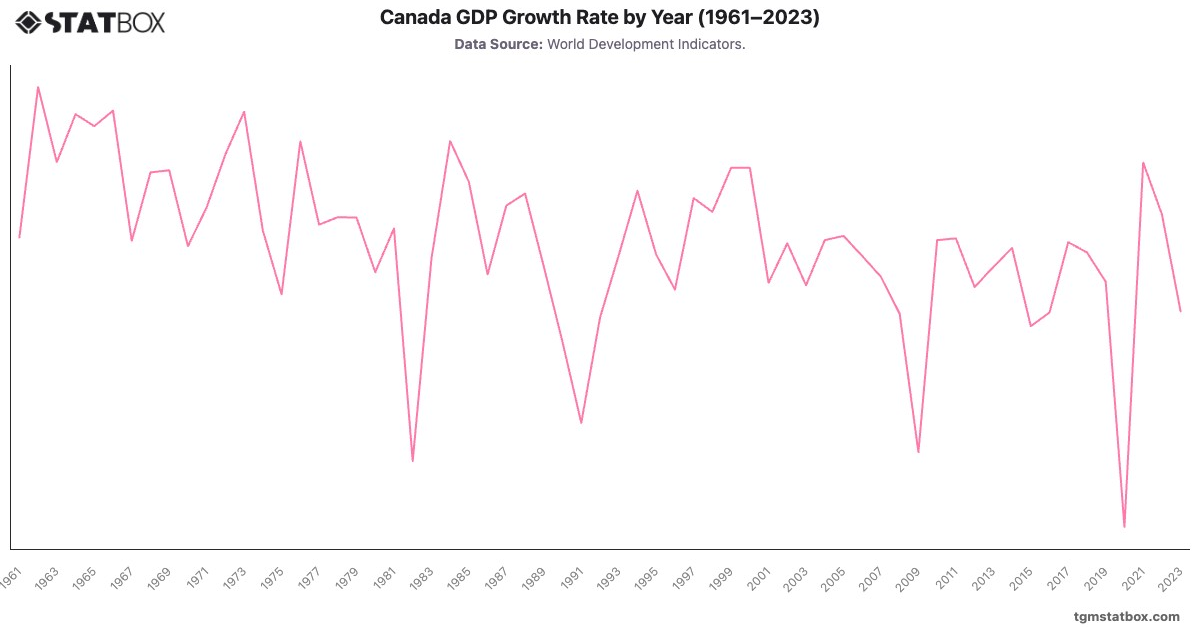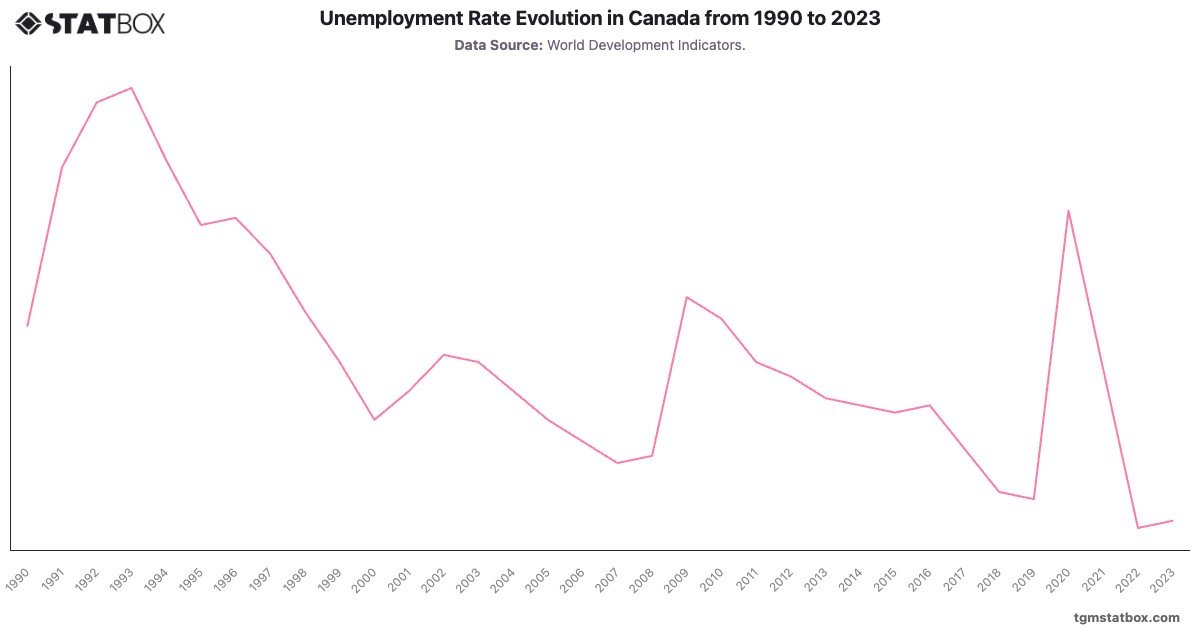
Canada's unemployment rate experienced fluctuations driven by economic cycles and global events. In the early 1990s, unemployment was high, reaching by 1993, influenced by the economic recession. A period of growth ensued, and by the early 2000s, unemployment had decreased significantly to around . The global financial crisis in 2008, however, saw an increase to in 2009, underscoring Canada’s susceptibility to external economic shocks.
From 2010 to 2019, Canada’s unemployment rate declined, reaching a low of in 2019. The COVID-19 pandemic in 2020 resulted in a sharp spike to , reflecting the widespread economic impact. By 2021, recovery efforts helped bring unemployment down to , indicating resilience and adaptation.
From 2010 to 2019, Canada’s unemployment rate declined, reaching a low of in 2019. The COVID-19 pandemic in 2020 resulted in a sharp spike to , reflecting the widespread economic impact. By 2021, recovery efforts helped bring unemployment down to , indicating resilience and adaptation.
For additional information, visit statistics on Canada’s public debt as a share of GDP, Canada’s population density, Canada’s population count.