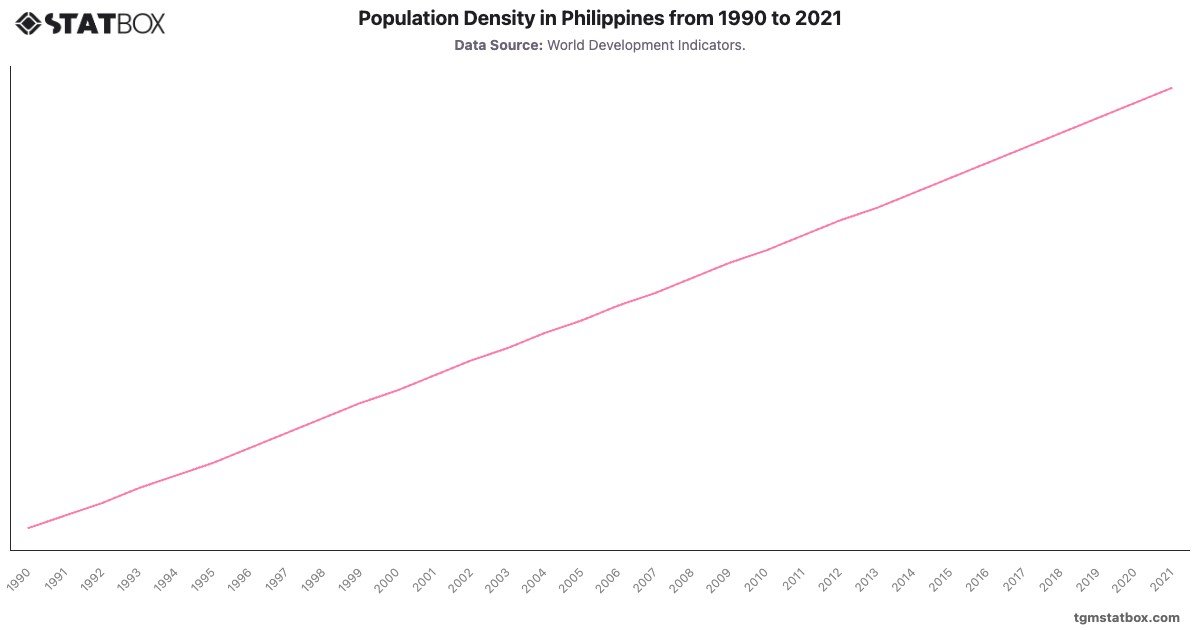
The Philippines saw rapid density growth, rising from 206 people per square kilometer in 1990 to 382 in 2021. The growth is driven by urbanization in Metro Manila, Cebu, and Davao, with people migrating from rural to urban areas for better economic opportunities. High birth rates in the 1990s also contributed significantly to this rise, leading to dense city populations.
As urban centers expand, rural depopulation balances the national density. The Philippines’ density reflects high urbanization, particularly in economic hubs, with demographic pressure likely to drive future trends.
As urban centers expand, rural depopulation balances the national density. The Philippines’ density reflects high urbanization, particularly in economic hubs, with demographic pressure likely to drive future trends.
Find out more through related statistics on Philippines’ population growth rate, Philippines’ population data, Philippines’ urbanization trend.