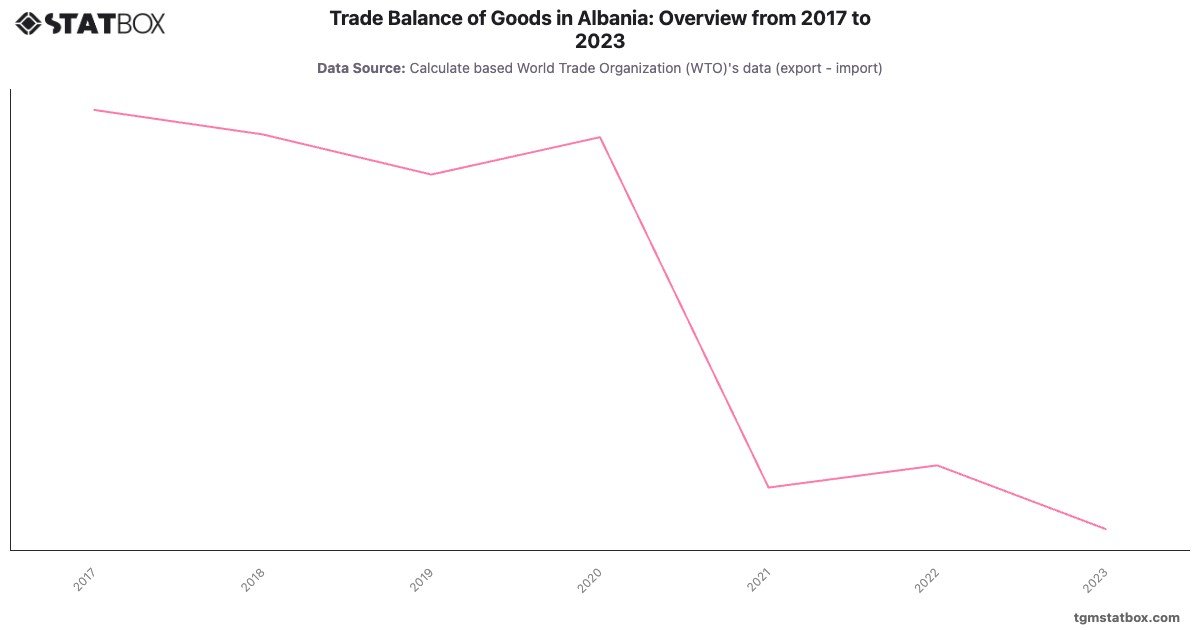
Albania experienced a consistently negative trade balance of goods from 2017 to 2023, with notable fluctuations. The deficit widened from -2,978.6 million USD in 2017 to -4,288.8 million USD in 2023, reflecting a growing dependence on imports relative to exports. A sharp increase in the deficit occurred in 2021, reaching -4,159.1 million USD, coinciding with post-pandemic economic recovery efforts and rising global commodity prices, which likely increased the cost of imported goods.
Although the trade deficit slightly narrowed in 2022, the overall trend indicates structural trade imbalances driven by Albania’s limited industrial base and reliance on imports for energy, machinery, and consumer goods. Export growth in sectors such as textiles and minerals was insufficient to offset the rise in imports, maintaining a negative trade balance trajectory.
Although the trade deficit slightly narrowed in 2022, the overall trend indicates structural trade imbalances driven by Albania’s limited industrial base and reliance on imports for energy, machinery, and consumer goods. Export growth in sectors such as textiles and minerals was insufficient to offset the rise in imports, maintaining a negative trade balance trajectory.
For a deeper dive into the topic, explore Albania’s urbanization trend, Albania’s annual GDP data, Albania’s agriculture share in GDP.