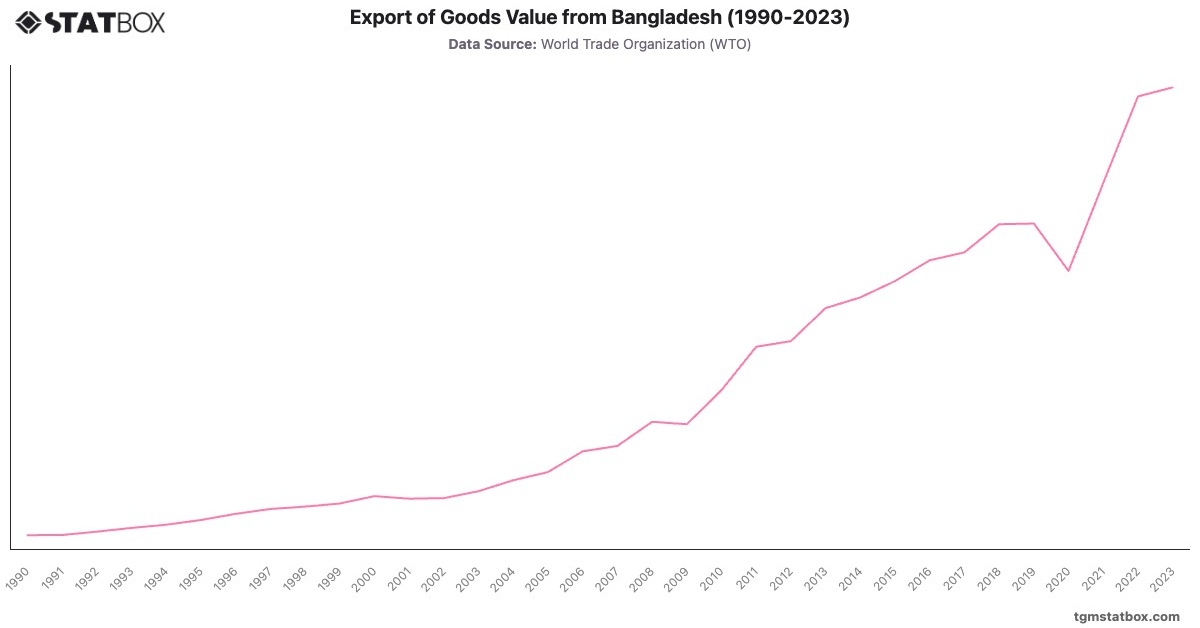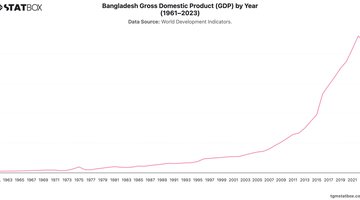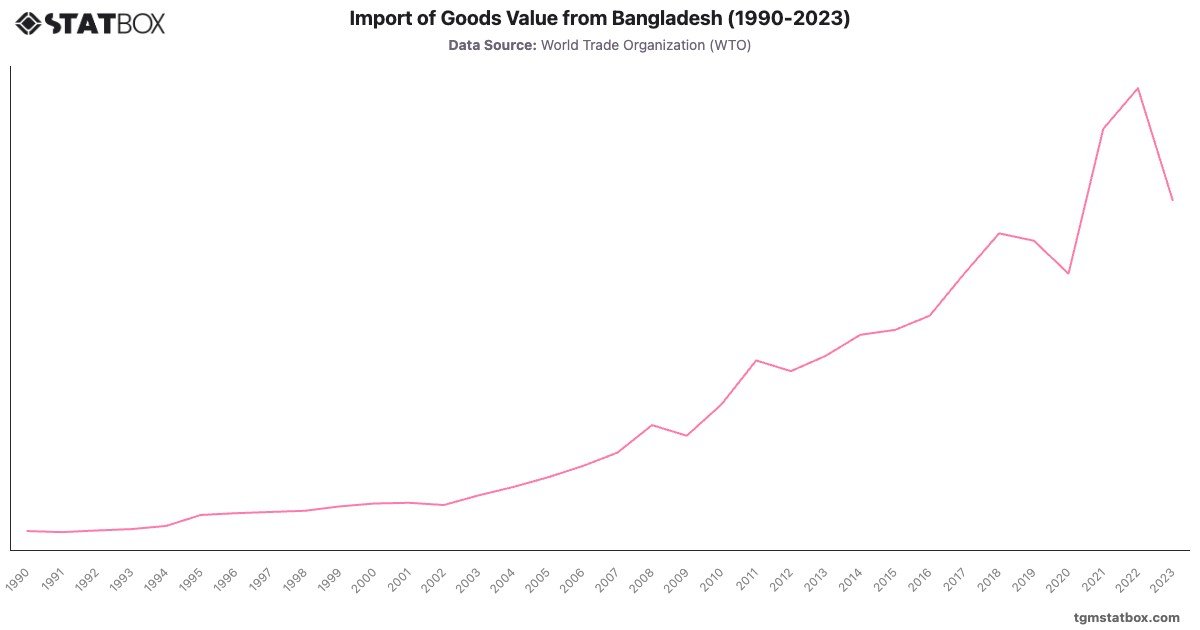
Bangladesh's import value showed consistent growth over the decades, highlighting its expanding economy and industrialization. From $3.6B in 1990, imports rose to $8.8B in 2000, driven by increased demand for raw materials and machinery to support its burgeoning textile sector. The rapid industrialization and export-oriented economy boosted imports, culminating in a significant rise to $23.8B in 2008 before a brief decline during the global financial crisis.
The period from 2010 to 2022 saw exponential growth, with imports peaking at $88.2B in 2022. This surge reflects Bangladesh's growing consumer market and investment in infrastructure projects. However, a dip to $66.8B in 2023 indicates adjustments due to global economic pressures and domestic economic policies. These trends underline Bangladesh's transformation into a key player in global trade, supported by its strategic focus on industrial and infrastructural expansion.
The period from 2010 to 2022 saw exponential growth, with imports peaking at $88.2B in 2022. This surge reflects Bangladesh's growing consumer market and investment in infrastructure projects. However, a dip to $66.8B in 2023 indicates adjustments due to global economic pressures and domestic economic policies. These trends underline Bangladesh's transformation into a key player in global trade, supported by its strategic focus on industrial and infrastructural expansion.
Find out more through related statistics on Urbanization rate in Bangladesh, Bangladesh’s population growth, Bangladesh’s services sector share in GDP.