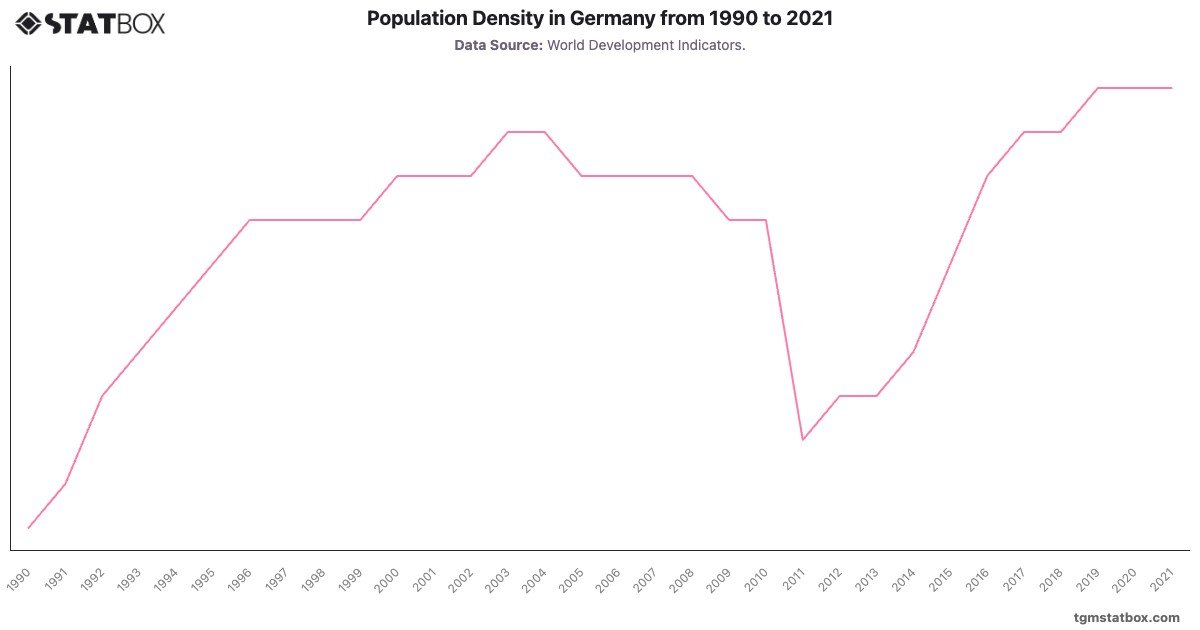
Germany's population density shows a relatively stable pattern, with minor fluctuations from 228 to 238 people per square kilometer. Reunification in 1990 played a role, as integration of the former East Germany gradually influenced population distribution. Major urban areas like Berlin, Munich, and Hamburg remain densely populated, contributing to Germany’s steady density figures.
By 2011, Germany experienced a slight dip due to demographic shifts, but this reversed with immigration boosts in the mid-2010s. Despite high urbanization levels, Germany's population density stabilized in the later years, showing Germany’s balance between urban areas and rural population dispersal, supported by a robust infrastructure.
By 2011, Germany experienced a slight dip due to demographic shifts, but this reversed with immigration boosts in the mid-2010s. Despite high urbanization levels, Germany's population density stabilized in the later years, showing Germany’s balance between urban areas and rural population dispersal, supported by a robust infrastructure.
For additional information, visit statistics on Germany’s mortality rate trends, Germany’s average lifespan, Germany’s urbanization rate.